Choosing the Right Odoo Modules for Your Industry
An ERP rollout succeeds or fails long before go‑live—often at the moment you decide which Odoo modules to use. Pick the wrong mix, and your teams end up fighting the system. Choose modules that mirror your industry and real workflows, and suddenly Odoo feels like a natural part of everyday work instead of an extra reporting chore.
Understanding ERP and Its Importance
ERP is your business’s coordination layer, uniting finance, sales, purchasing, inventory, projects, HR, and operations on one shared platform. This is what turns scattered activities into a connected, manageable operation.
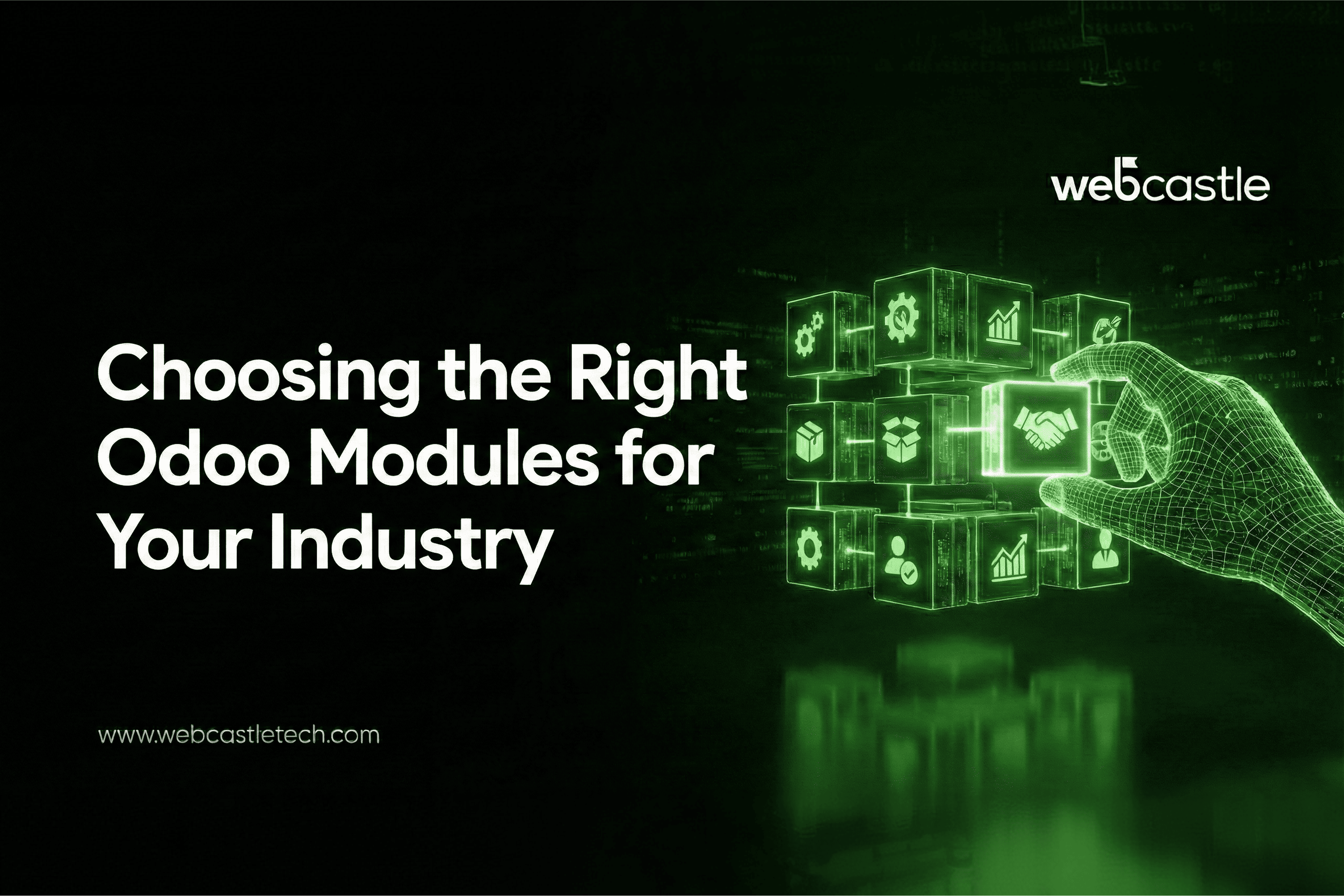
Odoo fits perfectly into this idea because it is built from separate apps you can combine as needed. Each app—CRM, Sales, Accounting, Inventory, Manufacturing, eCommerce—builds your system. Add modules as you grow.
Choosing the Right Odoo Modules
Before enabling a module, review your company’s workflow. Ignore the org chart for a moment and focus on actions:
- How do you capture and close deals?
- How do you promise, ship, and invoice orders?
- How do you buy, receive, and control materials or stock?
- How do you plan and deliver services or resolve support issues?
Once journeys are clear, it’s easier to choose the right ERP modules:
- Inventory and Purchase to handle stock and procurement.
- Project and Timesheets for service delivery and internal projects.
- Helpdesk or Field Service for after‑sales support.
- Accounting for billing, payments, and financial control.
A few simple rules help keep your first phase clean:
- Start with processes that hurt the most or carry the highest business risk.
- Leave “nice‑to‑have” features for later, once teams are comfortable.
- Plan integrations with existing tools early, not after go-live.
- Use industry ERP patterns as guidance: retailers, manufacturers, and service firms naturally need different combinations.
Retail uses PoS, eCommerce, Inventory, Purchase, and Accounting. Manufacturing uses MRP, BoM, Work Orders, Quality, Maintenance, Inventory, and Purchase. Service‑driven companies lean on CRM, Sales, Project, Timesheets, Invoicing, and Expenses.
Benefits of Customising ERP for Your Industry
Standard Odoo covers a lot, but every industry has its own quirks. That is where Odoo customisation becomes your advantage rather than a luxury.
With the right adjustments, you can:
- Rename and reorganise fields so screens match the terms your teams actually use.
- Enforce validation rules so people cannot skip critical steps or leave key data blank.
- Automate approvals, notifications, and calculations specific to your work (quality checks, milestone billing, warranty steps, compliance checks).
- Add focused extensions only where your industry needs something beyond the standard features.
You are not trying to turn Odoo into a unique, one‑off system. You are shaping it just enough so users recognise their daily work inside the screens. When that happens, adoption goes up, training becomes easier, and leadership finally gets accurate, timely numbers without chasing updates in ten different places.
Odoo in Action Across Sectors
Odoo’s modular design lets each business customise the platform differently. A few typical patterns:
- Retail and eCommerce Front‑office: PoS, eCommerce site, customer portal.
- Back‑office: Inventory, Purchasing, Shipping, and Accounting tools.
- Outcome: Staff handle orders, stock, and payments in one system.
- Manufacturing and distribution Core apps: Manufacturing, Inventory, Purchase, and Accounting.
- Outcome: Better control and smoother production planning.
- Professional and project‑based services Core apps: CRM, Sales, Projects, Timesheets, Invoicing, Expenses.
- Outcome: Clearer margins and faster, accurate invoicing.
Start with the right setup, then customise Odoo for your industry.
Why a Local ERP Partner in Kerala or India Helps
Choosing Odoo modules is easier when you have someone who understands both the product and your local business environment. An experienced erp software company in Kerala or a trusted erp software company in India can balance Odoo’s capabilities with realities like GST, Indian accounting norms, approval culture, and documentation standards.
WebCastle Media is a good example of such a partner. As an ERP software company in Kerala\ with strong Odoo expertise and delivery experience across India, WebCastle helps you move from “list of features” to a working, industry‑fit solution. Their team can:
- Run workshops to capture how your processes truly work today.
- Propose a focused selection of ERP modules instead of overwhelming you with everything at once.
- Design and implement Odoo customisation that stays stable and upgrade‑friendly.
- Provide ongoing support so your ERP can grow and adapt with your business.
Take the Next Step Towards Your Business Transformation
Odoo’s impact comes from choosing the right modules and tailoring them to your team. Ask: which processes to fix first, which modules help most, and where can Odoo customisation give an edge?
By collaborating with a capable erp software company in Kerala or an experienced ERP software company in India like WebCastle Media, you can build business software solutions that are both robust today and ready for whatever your next stage of growth demands.
Transform your business with Odoo. Work with WebCastle Media to select the right modules, customise your ERP, and streamline your operations.